THE SOUTH CHINA SEA DISPUTE AND SINO-VIETNAMESE RECONCILIATION
Nguồn và giấy phép
- Tên bài
- THE SOUTH CHINA SEA DISPUTE AND SINO-VIETNAMESE RECONCILIATION
- Tác giả
- Ku Boon Dar
- Tạp chí
- Journal of International Studies, 2023
- DOI
- 10.32890/jis2023.19.1.2
- Giấy phép
- CC BY 4.0
Đã chuyển định dạng từ bản gốc; nội dung không thay đổi.
Xem bản gốc
How to cite this article:
Dar, K. B. (2023). The South China Sea dispute and Sino-Vietnamese reconciliation. Journal of International Studies, 19(1), 37-59. https://doi.org/10.32890/jis2023.19.1.2
THE SOUTH CHINA SEA DISPUTE AND SINO-VIETNAMESE RECONCILIATION
Ku Boon Dar
School of Distance Education, Universiti Sains Malaysia
Received: 17/6/2022 Revised: 2/7/2022 Accepted: 12/10/2022 Published: 17/4/2023
ABSTRACT
This article attempts to analyse the South China Sea (SCS) conflict from the standpoints of both Vietnam and China. The paper discusses the factors that contributed to the recent escalation of the Vietnam-China conflict, the implications of the competition for Vietnam and other regions of interest, including the People's Republic of China and the United States, and the potentially desirable Association of Southeast Asian Nations (ASEAN) solutions. The research method was based on reviews of recent reports and surveys published in newspapers or think tanks. This qualitative analysis elucidates and deepens our understanding of the SCS dispute. The research is significant because it sheds light on the issues at stake, particularly from the perspective of Vietnam, an ASEAN member. With this in mind, the hope is that academics and stakeholders can make the best possible use of the data, various arguments, and analyses presented to advance knowledge through correction and further research. To resolve this issue, the study concluded that China and Vietnam must meet and discuss it. The United States' involvement in this maritime dispute complicates an already complex situation.
Keywords: South China Sea (SCS), China-Vietnam relations, Association of Southeast Asian Nations (ASEAN), United States, maritime dispute.
INTRODUCTION
Vietnam's relations with China are complex and problematic to some degree. People in Hanoi and Beijing have written lengthy diplomatic statements praising the integrity of their similar ideologies and systems of government. This political demonstration of goodwill is frequently distorted by territorial disputes in the South China Sea (SCS), security concerns, and geopolitical tensions. In recent years, China has been perceived as taking a more assertive stance in its relations with Vietnam. Despite this, Hanoi has attempted to maintain a more cautious approach to avoid providing China with an excuse to find fault with the Vietnamese. In its diplomatic relations with China, Vietnam has practised an open-door policy. Simultaneously, however, Vietnam has consistently stated that it will protect its sovereignty and rights by establishing diplomatic relations with other countries and strengthening its ties with them. Furthermore, Vietnamese leaders must face the election results from last August. As described by the proverb, "It is like pulling hair in flour: hair does not break, flour does not scatter." The way these two countries balance these options will be a crucial indicator of how China responds to the growing influence of Vietnam, with whom it shares a 1,000-kilometre border. Thus, this article aims to comprehend and analyse some of the most contentious issues in the disputes through the research and analysis of newspaper reports in Vietnam and China. This is accomplished by utilising mass media coverage of interviews with experts and individuals directly involved in and affected by the disputes. Through the prism of international relations theories, an attempt was made to understand how stakeholders, international agencies, and organisations perceive international disputes. A research method using mass media is essential in reviewing the situations and points of view in both countries because the international relations established by a government are usually based primarily on analyses of the current situation by experts and scholars.
LITERATURE REVIEW
Numerous works have examined the SCS disputes, but most are historical or legal. These articles focused primarily on the political dimensions of the SCS conflicts in general. However, there is still a dearth of specialists on the Sino-Vietnamese issue over the SCS. For example, Tonnesson (2003), Amer (2014), Hayton (2014), and Treflode (2016), to name a few, explored developments in the SCS by focusing on the China-Vietnam relationship. The authors showed how Sino-Vietnamese relations have changed since the two countries fully normalised their relationship in late 1991. The same is true of studies by Thayer (2016) and De Gurung (2018), which examined Vietnam's approach to maintaining autonomy in its relations with China due to territorial disputes in the SCS. Vietnam's approach to territorial conflicts in the SCS is cooperation and struggle. Vietnam has tried to prevent maritime border issues from affecting Vietnam's comprehensive strategic partnership in its collaboration with China. Simultaneously, Vietnam has tried to resolve its naval conflicts with China through diplomatic channels. However, nearly a decade of research has revealed significant changes in both countries' difficulties in managing disputes and the associated tensions in the SCS.
Similarly, a recent study by Capie (2020) argued that China-Vietnam relations could partly respond to China's selective competition with regional societies over specific "deep rules", most notably its challenges in respect of the mutual understanding of regional sovereignty and diplomacy. However, whether one agrees with the United States (US) factor, discussions of Vietnam-China relations cannot ignore its existence. Domestic politics, economic structure, and persistent doubts about the enduring power of the US constrain the partnership, requiring an element of hedging, even as Vietnam seeks to maintain US involvement in Asia.
As such, this article attempts to distinguish itself from several other works by emphasising that it is a comprehensive study that spans the period from the onset of the problem to recent developments, such as Chinese military advances in the SCS and American Vice President Kamala Harris' visit to Vietnam in 2021 (Al Jazeera, 2021). Additionally, the article examines scholars' views concerning the dominant theories of international relations to better understand how China and Vietnam approach SCS disputes. There are numerous viewpoints on the central issues of the SCS and possible resolutions to the conflicts. Consequently, several questions were addressed in this article: What are the fundamental issues at stake in the China/Vietnam SCS controversies? What constraints are at stake in these seemingly endless SCS squabbles? ASEAN (Association of Southeast Asian Nations) has the ability and responsibility to contribute constructively to resolving the SCS disputes; why is Vietnam significantly more vocal in its SCS disputes than the other claimants?
METHODOLOGY AND SOURCES OF DATA
This research on the SCS conflict is descriptive-analytical and attempts to explain the problems caused by the conflict and their consequences through an analysis from a particular perspective. The current study's methodology was qualitative analysis, which provides empirical evidence regarding the Sino-Vietnamese SCS dispute. The data collection process began with a review of the literature, followed by the use of information sources that directly reported on events and developments in the SCS conflict. This study employed a qualitative approach, which entails the analysis of both primary and secondary data. The data for this analysis came from scholarly works and articles on the Sino-Vietnamese SCS dispute, as well as perspectives from columnists and experts published in local and international newspapers. Secondary data sources were also analysed, including books, journal articles, reports, newspapers, and the internet. The analysis adds critical explanations for long-standing conflicts. However, liberal and constructivist scholars argue that international relations are not solely about power; they are also about how states perceive other states and how shared norms and values influence their behaviours. Regarding international affairs, the ASEAN Way is not just a name for ASEAN's internal norm standard but also a regional approach. This is a crucial element of the piece.
SINO-VIETNAMESE: A COMRADESHIP ON THE BRINK
Vietnam and China share a deep but occasionally uneasy diplomatic history. The two countries began interacting thousands of years ago, but 2020 marked the 70th anniversary of establishing official diplomatic relations between their respective political administrations. The Democratic Republic of Vietnam, often known as North Vietnam, was recognised by the People's Republic of China on January 18, 1950, and diplomatic ties were established. Later that month, a highranking commander from the Chinese Communist Party, Luo Guibo (1907–1995), was dispatched to Vietnam to aid Ho Chi Minh's soldiers in their struggle against France. The Chinese Communist Party is committed to assisting revolutions across Asia (Hill, 1992); the two countries thus formalised neighbour relations to adhere to the principle of China-Vietnam friendly relations for peace, stability, and prosperity (Linh Pham, 2021).
As the two nations marked their 72nd year of diplomatic relations (January 18, 1950–2021), the official government media for both countries reaffirmed that 2022 is an important milestone that will deepen their robust, amicable, party-to-party, state-to-state, and country-to-country relationship. Even though this is a staged celebration, several events have affected the relationship between the two countries and led to mounting tensions, as well as weakened camaraderie and a growing sense of competition. Therefore, some scholars believe that the diplomatic bond between Hanoi and Beijing is unfriendly. Huong Le Thu (2017), a senior Australian Institute of Strategic Policy analyst, predicted friction between Vietnam and China.
For example, when in May 2014, the China National Offshore Oil Company deployed the Haiyang Shiyou 981 oil rig to Vietnam's claimed exclusive economic zone. There was a real threat that the crisis would escalate into a conflict. The Vietnamese saw the incident as the most dangerous development in Sino-Vietnamese relations since the 1979 border war. Although the crisis was eventually resolved without an escalation, it attracted the attention of foreign powers and has not only had an enduring effect on the bilateral relationship but also exposed the fragility of regional stability.
The present regimes' diplomacy is founded on a millennium of history. Both sides have frequently encountered obstacles in promoting a positive image of the region. The relationship between China and Vietnam has cycled through deterioration and normalisation. Still, according to Huong Le Thu (2017), the connection is currently at one of its lowest points since the 1980s, a chaotic decade for the countries. They also fought on the high seas in 1988, when Vietnam claimed China seized the Gạc Ma Reef (referred to as both the Chigua Jiao in Mandarin Chinese and the Johnson South Reef). This conflict resulted in the deaths of many Vietnamese soldiers and civilians. Vietnam Express-News (2017) reported that on March 14, 1988, 64 Vietnamese troops perished defending Spratly Archipelago reefs, and Vietnam lost Gạc Ma. Tensions eventually subsided, and after fighting a brief border war, the Chinese PLA and the Vietnam People's Army formally normalised relations in November 1991.
Several bilateral agreements were reached once their concerns were fully normalised. When Jiang Zemin and Premier Li Peng met with Vietnamese General Secretary Do Muoi and Prime Minister Vo Van Kiet in the Great Hall of the People, an official announcement was made (Thayer, 1994). In forging diplomatic relations, their joint statement stressed that the two nations must adhere to the principles of friendliness and pursue a common purpose in following guidelines for bilateral relations that include a friendly neighbourhood, broad collaboration, long-term stability, and a forward-thinking attitude. An 11-point joint communique laid out the basis and principles of state and party relations. Both sides agreed "not to seek hegemony in any form" and that "no country should impose its ideology, values or mode of development upon other countries" (Thayer, 2016). The joint declaration also established four symbolic roles for the countries: correct neighbours, top comrades, suitable friends, and accurate partners.
Vietnam and China normalised their relations when Hanoi was sidelined in diplomatic ties because of its communist ideological concerns during the height of the Cold War. As a result of the collapse of the Soviet Union, Vietnam's only ally at the time, Hanoi, remained cut off from the rest of the world. Vietnam was not yet a member of ASEAN, nor had it normalised relations with the US. Put simply, Vietnam was virtually cut off from the international community for a long time. Additionally, Vietnam received little help and was besieged due to a deficiency in global commerce. The end of the Cold War and the Paris Agreement relating to Cambodia in October 1991 changed the regional context, making a Vietnam-ASEAN reconciliation conceivable and desirable. In the early 1990s, Vietnam moved closer to ASEAN members and joined the organisation as a full member on July 28, 1995. As a result, China's prior support of Vietnam is much valued. However, the improvement of China-Vietnam ties is contingent on Hanoi's concessions and principles. Particular emphasis has been placed on the implementation of the "Four-Nos" national security plan, as asserted by Li Jianggang (2021):
The "Four No's" policy includes no military alliance, no affiliation with one country to counteract the other, no foreign military base in the Vietnamese territory to act against other countries, and no force or threatening to use power in international relations; the year adopted; and the context of its adoption.
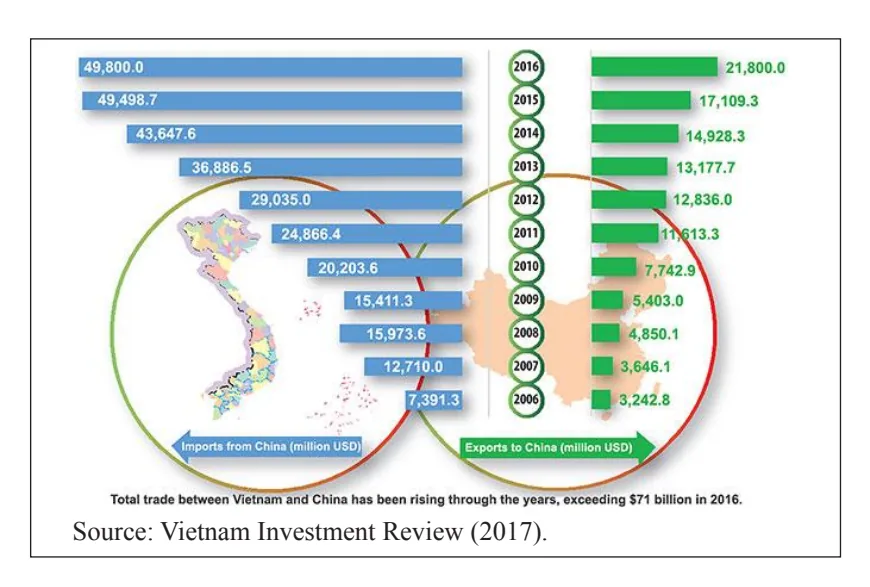
As asserted by Grossman and Huynh (2019), Vietnam's attitude is to "[form] military alliances... [parallel] with one country with another [geopolitically], and... [host] a foreign military base on Vietnamese soil." The agreement with Beijing was that Hanoi would not threaten China's borders. Furthermore, as reported by the Vietnam Investment Review (2017), Vietnam depends on China for its imports and exports (see Map 1). Meanwhile, according to a Hanoi News report (2021), since 2004, China has been Vietnam's largest trading partner. In 2019, Vietnam's two-way commerce reached approximately $117 billion, with $41.4 billion in exports and $75.45 billion in imports (Linh Pham, 2021).
Vietnam-China Trade Balance Shows Improvement
Foreign Policy and Maritime Disputes
On the one hand, normalisation does not eliminate all distinctions between Beijing and Hanoi. While diplomacy has mended specific gaps, inevitable conflicts have proven more challenging to manage and have even intensified over time. One example of a successful negotiating attempt occurred during the 1990s when bilateral disagreements in the Gulf of Tonkin were resolved. After years of negotiations, the nations reached a final agreement in 2000, which served as an example of how neighbours may work together to settle their concerns. On the other hand, the diplomatic resolution of the SCS maritime territorial dispute over the Spratly and Paracel Islands has proven to be more challenging. The SCS is of particular significance to both Vietnam and China. However, although Vietnam's coastline on the SCS is more than 3,000 kilometres long and with 4,000 large and small islands, China has strategically prioritised sovereignty over these seas. Hu Jintao, the Chinese president at the time, expressed his goal to transform the country into a mighty maritime power (South China Morning Post, 2012):
"We should enhance our capacity for exploiting marine resources, resolutely safeguard China's maritime rights and interests, and build China into a maritime power."
Consequently, Beijing's intentions to exert authority over the SCS became increasingly apparent. Xi Jinping became China's president on March 14, 2013. Since then, the country's aggressive reclamation operations, the militarisation of adjoining maritime features under its control, and involvement in coercive measures in the sea and its surrounding waters have made the maritime domain even more forceful (Huong Le Thu, 2020). Vietnam and China are still at odds on this issue, a significant source of friction. The latter thus exerts considerable influence on Vietnamese foreign policy decisions on the best course of action. The geographic proximity of Vietnam to these waterways hinders China's objectives in the SCS.
Furthermore, numerous other countries, most notably the US, consider Hanoi's posture to be a significant stumbling block to China's maritime growth. Beijing's recent aggressive and provocative behaviour in the SCS has prompted Hanoi to question the Chinese government's commitment to resolving this conflict peacefully and equitably. Indeed, Thayer (2016) outlined Vietnam's autonomous approach in light of unequal ties with China.
The Vietnamese government has attempted to interact with Beijing to narrow the power discrepancy gap with its larger neighbours. According to the Vietnamese government, as Huong Le Thu (2020) noted, Vietnam has endeavoured to defend its sovereignty with China by "cooperating while striving". While mistrust remains, Hanoi and Beijing have developed new communication channels that include party-to-party discussions, defence-focused engagement and direct phone lines to address emergencies in the SCS (Huong Le Thu, 2020). The long-standing disagreements between the two nations have not wholly absorbed or exacerbated their bilateral relationship. Indeed, they are not the only essential facet of their bilateral relationship at odds with one another. Vietnam has received high accolades for successfully compartmentalising maritime problems with China while collaborating in other areas, such as economic growth, infrastructure, education, and political discussion with the Chinese government. On the other hand, this fragile equilibrium has weakened in recent years. Even according to Thayer (2016):
"Vietnam pursues a 'cooperation and struggles' strategy with China over maritime disputes in the SCS. Vietnam's leaders have attempted to prevent maritime boundary disputes from spilling over and negatively impacting Vietnam's comprehensive strategic cooperative partnership with China. At the same time, Vietnam has attempted to manage its maritime disputes with China through government-to-government negotiations and in times of crisis through party-to-party channels."
A notable turning point was reached in mid-2014 involving Haiyang Shiyou (HYSY) 981, a Chinese-operated oil rig in the SCS off the coast of Vietnam. It provoked a severe bilateral dispute over the ownership of the SCS waters. As part of its Exclusive Economic Zone (EEZ), Vietnam claims ownership of the seas, a 1,395,096-squarekilometer EEZ that extends outward from its coast for 200 nautical miles (370.4 km). In contrast, China claims ownership of the waters, including the Paracel (Xisha) Islands, located off the coast of southern China, over which China and Vietnam were in contention. For weeks, Chinese and Vietnamese ships were on the verge of an all-out war. This incident brought Hanoi and Beijing to the brink of open conflict for the first time since the 1988 causes of injury on Johnson South Reef. In response to the oil rig incident, the Vietnamese government launched a global media campaign to educate the public about China's growing influence in the SCS (Huong Le Thu, 2020). Hanoi was forced to explore alternative measures to minimise the power imbalance between the two nations because of China's aggressive stance in the SCS. The episode ended with the China National Offshore Oil Corporation (CNOOC) removing the oil rig before it began operating. Zakaria Ahmad, a political scientist and the former Head of the Strategic and Security Studies Unit at the Universiti Kebangsaan Malaysia (UKM), as quoted by Ang Cheng Guan (2019), effectively summarised widespread opinion toward China when he remarked, referring to the two naval engagements between China and Vietnam in January 1974 and March 1988, "Do not forget, they (the Chinese) have a track record of using force in that part of the world" (Ang Cheng Guan, 2019).
During the oil rig crisis of 2014, Hanoi was reminded that its friendship with Beijing was fragile. China's foreign behaviour will be determined more by its size and power than by any attempt at ideological unification. Vietnam has taken various measures to protect its interests, including diplomatic allies. As usual, Beijing quickly extended a friendly hand to mend critical relations after the oil rig incident, causing a sharp deterioration in diplomatic relations. Chinese President Xi Jinping made a trip to Hanoi in 2015, but ties worsened as Beijing's aggressive acts persisted and deepened. During the summer of 2016, China rejected the decision of an independent tribunal in a case about territorial disputes in the SCS. In July 2016, the Permanent Court of Arbitration in The Hague ruled in favour of the Philippines in its United Nations Convention on the Law of the Sea (UNCLOS) legal challenge against China. The UNCLOS was established on December 10, 1982, and went into effect on November 16, 1994. To date, 167 countries, including 164 United Nations members, have joined the convention. UNCLOS paved the way for establishing an international marine constitution and balancing the interests of all rich and developing nations. This is the first global convention to define all territorial waters. Additionally, the convention is viewed as a charter for both the International Tribunal for the Law of the Sea (ITLOS) and the Commission on the Limits of the Continental Shelf (CLCS) (VOV, 2022). Despite China being party to the treaty that established the tribunal, it refuses to recognise its jurisdiction (The Guardian, 2016).
However, even though Vietnam was not involved, Beijing's ongoing disagreement with Hanoi was overshadowed by legal procedures between China and the Philippines (particularly the Chinese government's response to these processes). Former Philippine President Benigno Aquino III contested China's substantial territorial claims in the SCS within the nine-dash line (for further information, please refer to the map below) because of their weak legal foundation. China's historical claims were rejected by the 2016 tribunal, which Hanoi heartily backed. According to the tribunal, no reef or atoll in the Spratlys could be designated an island. As a result, Beijing's claim to a 200-mile EEZ was reduced by 50 percent (Hsiao-Chi Hsu, 2015).
Highlighted 9-dashed Line (in Green) on South China Sea Map Figure 2 Highlighted 9-dashed Line (in Green) on South China Sea Map
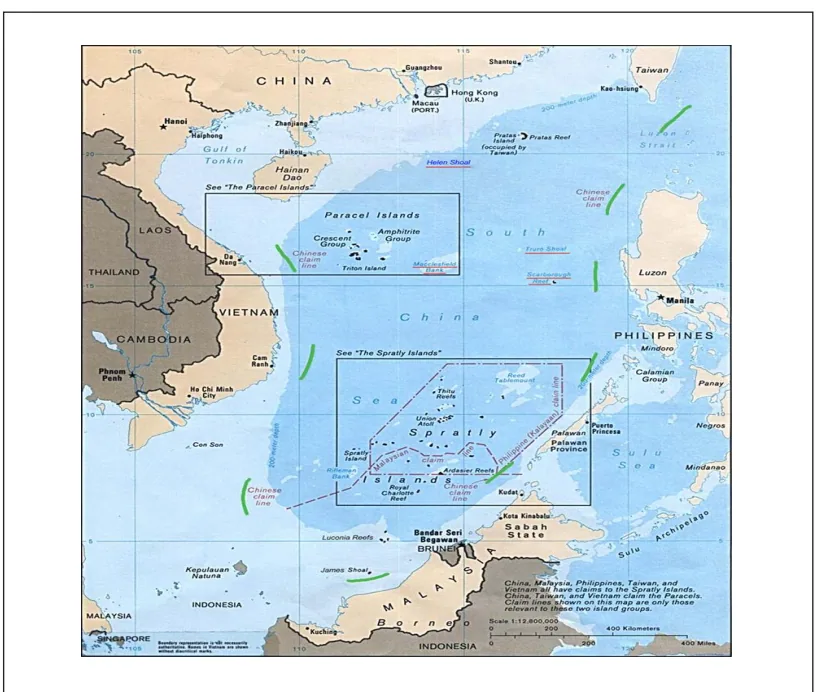
Map Collection: The South China Sea, 1988. Source: US Central Intelligence Agency – Asia Maps – Perry Castaneda Map Collection: The South China Sea, 1988.
Despite Vietnam's triumph, China refused to accept the decision and continued to defend its earlier claims. That refusal has not affected Vietnam, and numerous claimants have guaranteed that their national sovereignty to conduct commercial activity within their EEZs will be maintained. Vietnam has exerted pressure on China to change course even more than it has done previously. Huong Le Thu (2020) sees this as a sign of Xi Jinping's rising determination to take China's dominance head-on. As the SCS Despite Vietnam's triumph, China refused to accept the decision and continued to defend its earlier claims. That refusal has not affected Vietnam, and numerous claimants have guaranteed that their national sovereignty to conduct commercial activity within their EEZs will be maintained. Vietnam has exerted pressure on China to change course
even more than it has done previously. Huong Le Thu (2020) sees this as a sign of Xi Jinping's rising determination to take China's dominance head-on. As the SCS problem has taken centre stage within China-Vietnam ties, Beijing's change has left little opportunity for other areas of cooperation between the two countries to expand.
Because of this, China has exerted more influence on Vietnam in recent years, especially on maritime issues. Hanoi has dealt with this conflict in various ways, even though other countries, such as Brunei, Malaysia, and even the Philippines, have not been as aggressive towards China as they once were. The SCS is the site of territorial disputes between several sovereign countries, including Brunei, China, Taiwan, Malaysia, the Philippines, and Vietnam. Territorial disputes are ongoing in the Paracel and Spratly islands, in the Gulf of Tonkin, and elsewhere. Each nation's interests are bolstered by controlling vital shipping lanes, fishing rights surrounding the two island chains, and extracting oil and natural gas from the SCS. In contrast, China claims almost all of the SCS north of the so-called nine-dash line, which an international court determined was arbitrary in 2016. This is especially relevant in the Philippines. President Rodrigo Duterte has softened his country's attitude on the trade issue to entice Chinese investment and reap other diplomatic benefits. Dereck Aw, a senior analyst in Control Risk's Singapore headquarters, told Yen Nee Lee (2020) that the Duterte administration will continue to deepen economic engagement with China and refuse to internationalise the SCS dispute.
At the same time, Indonesia's approach has taken a cautious turn of late, mainly regarding an incident on August 31, 2021, when a Chinese survey vessel, the Haiyang Dizhi 10, entered the North Natuna Sea near a vital oil and gas field known as the Tuna Block. The ship, which appeared to be conducting a seismic survey, left briefly in September and returned in early October before leaving the waters on October 5, 2021. During a lecture at the Catholic University of America in Washington, DC, on October 18, Indonesia's Coordinating Minister of Maritime and Investment Affairs, Luhut Binsar Pandjaitan, appeared to play down the presence of the Chinese vessel in Indonesian-claimed waters, saying, "We respect freedom of navigation in the Natuna Sea" (Amy Chew, 2021). Of these countries, Vietnam is the most enthusiastic about pursuing its demands and being an active participant in the regional dispute. Following China's rise in confidence, assertiveness, and aggression, Hanoi may be the only entity standing in the way of Beijing's growing power.
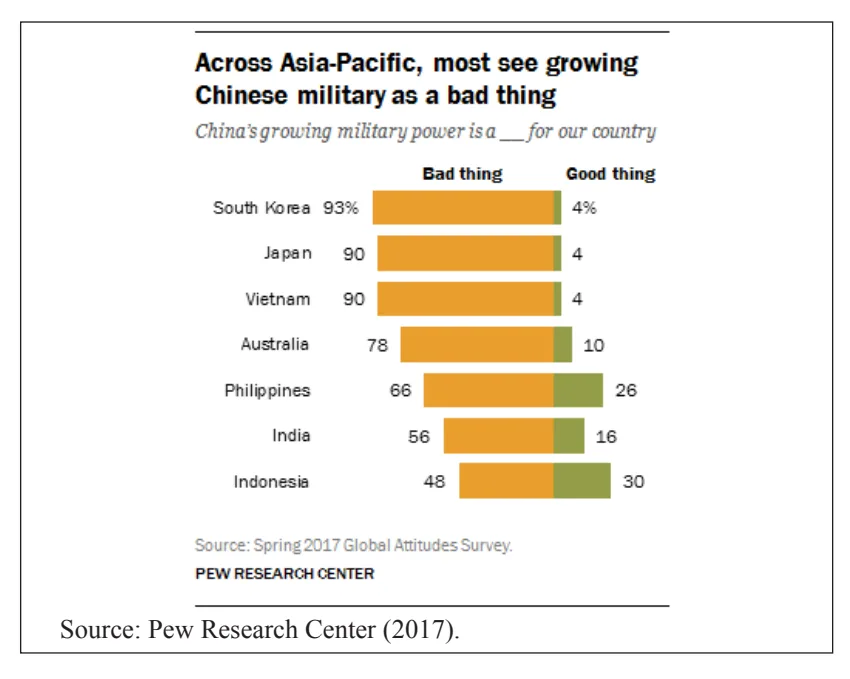
Any other position would likely be politically untenable in Vietnam. According to a survey by Silver (2017) of the Pew Research Centre, most people in the region are concerned about China's expanding military capability. In recent years, China's official military budget has increased by almost 9 percent. Most Vietnamese citizens, even those living in the seas of eastern and southern China, believe that China's expanding military might be detrimental to their nation, according to a recent survey conducted by the Pew Research Center (2017).
Across Asia-Pacific, Most See the Growing Chinese Military as a Bad Thing
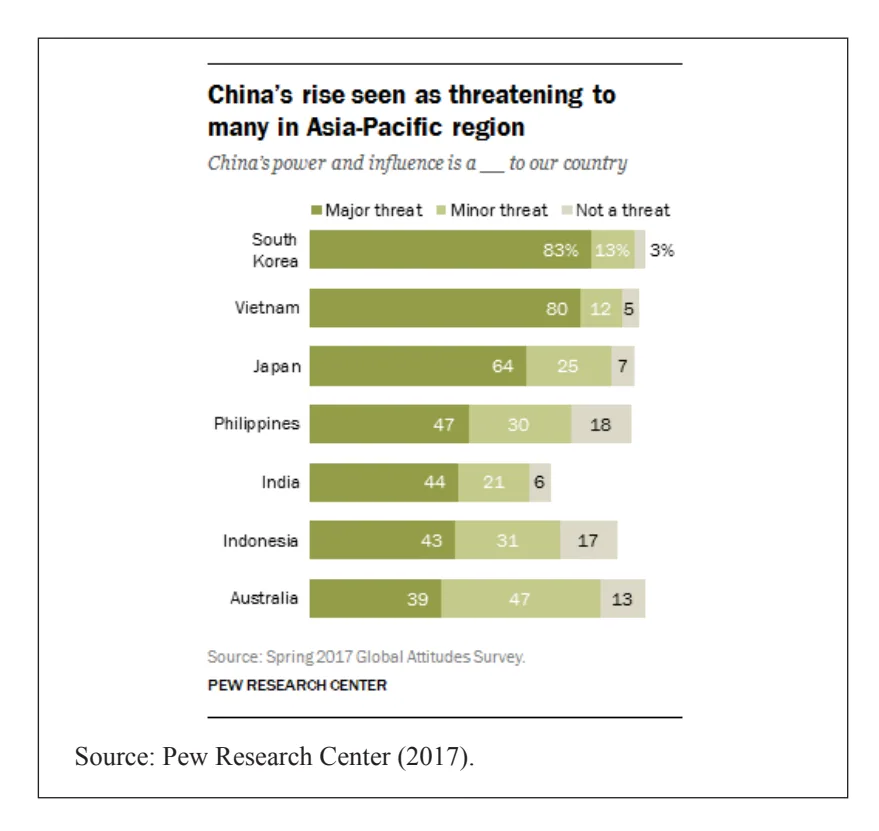
The Vietnamese consider China to be their greatest national security danger because of its size, economic might, and global influence. Indeed, China's dominance and power present a severe threat to Vietnam, with just 12 percent of respondents feeling it was moderately dangerous.
China's Rise is Seen as Threatening to Many in the Asia-Pacific Region
As a result, Treglode (2016) alleged that the Chinese government and domestic media had wrongly asserted that Hanoi behaved severely when it sabotaged conflict resolution and progress on the planned China-ASEAN Code of Conduct in the SCS. However, from Vietnam's perspective, as reported by Vietnam Express International portal news (VnExpress, 2017), what Beijing praised as progress in these negotiations did not benefit other Southeast Asian countries. Hanoi worried that the result would be an empty shell of an agreement rather than a meaningful mechanism for dispute resolution if the purported diplomatic progress did not prevent China's provocations. Even though a tribunal ruled in favour of Vietnam in 2016, Beijing claims it has the right to the area based on the nine-dash line and that Vietnam is therefore encroaching on its waters (Shukla, 2020).
The US's Role in the Maritime Dispute
China's international behaviour under Xi Jinping worries more than just Vietnam. Countries around the globe debate whether China's activities are motivated by genuine concern for peaceful coexistence or an effort to establish rights that it sees as fundamental in the international system. Moreover, during the COVID-19 pandemic, China accelerated its claims in the SCS. Chinese military aircraft crossed the Taiwan Strait's middle line and escalated patrols around the Japanese-controlled Senkaku Islands (Pence, 2020). Indeed, due to Beijing's attitude and behaviour the views of many other nations have changed, including Hanoi, which had previously had a divided assessment of China's potential danger. Protecting its interests and recognising a similar idea, Vietnam has sought to strengthen further diplomatic relations and partnerships with other major world powers, including Japan, the European Union, Australia, India, and the US. As reported by Hong Kong Nguyen and Pham Muoi Guyen (2021):
In official diplomatic terms, Vietnam and China signed a comprehensive strategic partnership in 2009, a designation shared by only Russia (2012) and India (2016). Additionally, Vietnam has established strategic partnerships with nine other countries: Japan (2006), South Korea (2009), Spain (2009), the United Kingdom (2010), Germany (2011), and Italy, Singapore, Thailand, and Indonesia (all four in 2013). The relationship with the US (and Australia) remains at the level of a comprehensive partnership.
Vietnam's focus on maritime issues has increased security and cooperation. Hanoi's relationship with the US and other countries must improve if they are to deal with China's threats. According to Ranjit Singh (2007), after the end of the Cold War in 1991, Southeast Asia was filled with dread over the possibility of regional powers, particularly China. However, this reconciliation does not mean that the US and Vietnam have become true allies, even though the relationship between the two countries remains strong. The trade deficit was a source of frustration for the Trump administration, and similar to Beijing, the White House viewed Hanoi as part of the problem. Trump once even called Vietnam the worst [trade] abuser and warned that the White House would be the next target for tariffs after China (The Guardian, 2019). Even though Vietnam and the US have struggled with their bilateral relations, they have worked together as remarkable partners in challenging times.
However, despite their disagreements, Hanoi wants the US to keep an eye on Southeast Asia and the SCS, as claimed by Chiacu and Bose (2021) and reported by Reuters (2021). As the only country in Southeast Asia that Trump visited twice during his first term as president, Vietnam was able to make an impression on him. In 2017, he was in Da Nang for the Asia-Pacific Economic Cooperation Summit, and in 2019 he met with North Korean leader Kim Jong Un, again in Hanoi. Nevertheless, many countries in Southeast Asia had a poor perception of the US under the Trump administration. In contrast, the administration of President Biden has prioritised rebuilding America's global partnerships, especially with Southeast Asian countries. In fact, on August 24, 2021, Kamala Harris became the first American Vice President to visit Vietnam. Her visit aimed to rally international support to counter China's growing influence. According to spokesperson Symone Sanders, Harris discussed regional security, the global response to COVID-19, climate change, and the US's joint efforts to promote a rules-based international order (Chiacu & Bose, 2021).
Washington has long sought to remain neutral regarding the SCS dispute, but with its increasingly intense competition with China, the US has changed its stance. In the SCS, the US State Department has regularly blasted China's treatment of Vietnam and accepted Hanoi's legal right to utilise resources in its EEZ. The US State Department stated in July 2020 that it openly rejected China's claims and backed the rights of Southeast Asian countries to use offshore resources. Because Vietnam has struggled politically and economically, this is a significant development. In the end, China held military drills in the region. They took every precaution to safeguard the occupation of these islands. To do this, it allegedly dispatched many ships to the area to deter other navies or sink fishing boats so that no one would venture there (WION Web Team, 2022).
Necessary Strategic Revisions
Beijing's reluctance to adhere to the ideals of good neighbourliness has been evident in recent SCS events. When a Chinese Coast Guard vessel collided with a Vietnamese fishing boat off the coast of Woody Island in April 2020, Vietnam was astonished. Foreign Minister Nguyen Xuan Phuc confirmed that a Chinese vessel had breached Vietnamese sovereignty in the Hoang Sa archipelago and jeopardised Vietnamese fishers' lives, property, and legitimate rights (Khanh Vu, 2020). Subsequently, Vietnam conducted an official protest at the United Nations over losing a fishing boat, which it claimed was hit and sunk by an armed Chinese surveillance vessel near the disputed SCS islands. From 2020 to 2021, Hanoi might use its place on the UN Security Council to express its concerns about the severe consequences of this maritime territorial conflict. However, according to Huong Le Thu (2020), these developments have not discouraged China.
The coronavirus outbreak may only serve to energise the people of Beijing. In areas of the SCS claimed by Vietnam and inhabited by the Vietnamese people for decades, China established two new administrative zones in April 2020. The Xisha and Nansha zones were established by Beijing in the Paracel Islands and the Spratly Islands, respectively. The Paracel Islands' Xisha zone and the Spratly Islands' Nansha zone have been set by Beijing and will be governed by the administration of Sansha, a tiny city erected on Woody Island and the Fiery Cross Reef that is administratively deemed to be part of China's Hainan Province. Beijing created these two districts to improve control of the island, enhance local infrastructure, and increase security. From the start, Hanoi blasted the action as an insult to Vietnam's sovereignty and a breach of diplomatic protocol (Huong Le Thu, 2020).
Challenges in Collaboration
The current issue relates to how to better understand how Vietnam's policy towards China and other regional diplomatic partners will evolve to meet the growing national security challenges. Pham Binh Minh, Vietnam's Deputy Prime Minister (and, up to 2021, its Minister of Foreign Affairs), addressed the ASEAN Summit and warned that threats to peace, stability, security, safety, and freedom of navigation in the SCS are the region's major challenges. Iwamoto from Nikkei Asia (2020) reported that Minh emphasised that ASEAN would retain its principled posture of self-control and peaceful resolution of all problems respecting international law, including the 1982 UNCLOS, facilitating dialogue and increasing confidence in nonmilitary cooperation to avoid further exacerbating the situation. In his joint statement, Deputy Prime Minister, Minh, drew attention to SCS conflict concerns and asked for conformity with UNCLOS (Iwamoto, 2020).
On April 26, 2021, China's State Councillor and Minister of National Defence, Wei Fenghe, led a high-ranking military delegation to meet with General Secretary of the Communist Party of Vietnam Central Committee Nguyen Phu Trong and Vietnamese President Nguyen Xuan Phuc in the capital of Hanoi. Trong congratulated China for its successes in combating COVID-19 and promoting economic growth and urged the two nations to maintain their longstanding friendship and strengthen their military ties. Trong also said that the two countries should work together to solve the SCS issue and protect their relationships. Phuc remarked that Vietnam is a staunch supporter of the One-China concept and rejects any military intervention in China's affairs (Echols, 2021). Phuc also noted that when other nations are battling China, Vietnam will stand steady and reject any attempts to harm relations between the two countries. State media from both countries stressed strengthening ties and bolstering strategic cooperation for peace, stability, and development. The Chinese state media stressed the need to prevent disputes in the SCS from harming relations and address competing issues with trust and respect (Xinhuanet, 2021).
However, this statement was refuted by some Vietnamese scholars. Ha Hoang Hop (2021) is a visiting senior fellow for Vietnamese Studies at Singapore's ISEAS-Yusof Ishak Institute. Hop based his opinion on a source present at the meeting and requested anonymity to relay the private sessions. "Vietnamese leaders never say anything [so specifically] detailing its relationship with China," Hop said, as reported in Global News by Yang Sheng and Deng Xiaoci (2021).
Meanwhile, domestic changes occurred in the Vietnam National Party Congress in 2021. Specifically, Vietnam's leaders revealed significant changes to vital political positions and staff during this critical political event, which occurs once every five years. The National Party Congress discussed new socioeconomic plans for 2021–2030 and other issues, including foreign policy. The future course of bilateral ties between Vietnam and China will be influenced by the nominations and processes of the 13th Party Congress of Vietnam, held in May 2021. New leadership cadres may have to decide on the answers to crucial questions. The SCS is one case where Hanoi has long delayed pursuing official legal action to preserve a peaceful neighbourhood; however, the Vietnamese government has now started to consider legal redress. Hanoi's rivalry with Beijing over the SCS and its perception of the threat of Chinese aggression are the primary motivations shaping its diplomatic posture. Thus far, Vietnam has consistently rejected any military intervention in China's domestic affairs and would firmly resist attempts to sabotage Vietnam-China ties. Phuc explained this during the historic visit of US Vice President Kamala Harris, where she criticised China's coercion and intimidation in the SCS (Xiahua, 2021).
While Vietnam entered the talks with modest ambition, Treglode (2016) discovered that China's primary goal was to reduce the disputes between the two countries by using this first maritime border agreement as a public display of diplomacy in Asia. The new and practical Sino-Vietnamese consensus in the Gulf of Tonkin is a step forward, yet the risk remains that the agreement will only have an impact in the short and medium terms. Both countries have described what has been accomplished regarding China-Vietnam collaboration in the Gulf of Tonkin since 2000. Most of these achievements relate to marine economic exploitation, focusing on fishing, joint fishing zones, and hydrocarbons. On the other hand, there have also been achievements associated with the formation of collaborative exploration and development zones; these alleged security operations also involve maritime police, coast guard, and navy. Subsequently, China and Vietnam should work together to ensure that the Gulf is safe for everyone.
CONCLUSION
Even in the SCS's contentious waters, cooperation is possible. Internationalising the conflict, resolving it in a multilateral framework like ASEAN, deterring China from using military force as much as possible, and maintaining diplomatic channels with Beijing are the four primary components of Hanoi's SCS policy. Due to these and other marine problems, Vietnam has maintained its status as a leading international voice. In addition to diplomatic efforts and fostering trust, Vietnam has also worked to increase the deterrent impact of its military forces. Vietnam's leaders interact with China in various ways, including party-to-party and through the armed services. Despite the vast power disparity between the two nations, Hanoi has attempted to close the gap as much as possible using a combination of soft and robust approaches. Due to their reliance on bilateral collaboration and goodwill, these measures have thus far been ineffective.
The coronavirus pandemic undermined the world community and caused a surprising lack of global leadership, aggravating Vietnam's problems. The US has been involved in the disputed matter but has sent mixed messages about its role and growing rivalry with China. Because Hanoi is a member of ASEAN, it is necessary to pursue diplomatic and legal solutions to the SCS dispute to uphold the principles of peaceful dispute resolution. Vietnam's people and leaders are unwilling to consider any response based on aggression or violence, owing to the country's Cold War history. However, with its new "Four No's", Hanoi has shown that it will not be held back as it seeks to maintain its freedom and independence. The two parties agreed to strictly adhere to high-level shared perspectives, manage conflicts, avoid complicating or exacerbating circumstances, and ensure peace and stability in the disputed seas.
ACKNOWLEDGMENT
This paper received no specific grant from any funding agency in the public, commercial, or not-for-profit sector.
REFERENCES
-
Al Jazeera. (2021, August 24). Kamala Harris accuses China of intimidation 'in the South China Sea. Al Jazeera. https://www. aljazeera.com/news/2021/8/24/us-vp-harris-accuses-china-ofintimidation-in-south-china-sea
-
Amer, R. (2014). China, Vietnam, and the South China Sea: Disputes and dispute management. Ocean Development & International Law, 45(1), 17-40.
-
Amy Chew. (2021, October 20). South China Sea: Why Malaysia and Indonesia differ in countering Beijing's maritime claims. South China Morning Post. https://www.scmp.com/week-asia/ politics/article/3153932/south-china-sea-why-malaysia-andindonesia-differ-countering
-
Capie, D. (2020). The power of partnerships: US defence ties with Indonesia, Singapore and Vietnam, International Politics, 57, 242–258.
-
Chiacu, D., & Bose, N. (2021, July 31). US Vice President Harris to visit Vietnam and Singapore. The Reuters. https://www.reuters. com/world/asia-pacific/us-vp-harris-visit-vietnam-singaporewhite-house-2021-07-30/
-
De Gurung, A. S. B. (2018). China, Vietnam and the South China Sea. Indian Journal of Asian Affairs, 31(1), 1-20.
-
Echols, W. (2021). Did Vow to Never Oppose China? Doubtful. Polygraph Info. https://www.polygraph.info/a/fact-checkchina-vietnam-no-opposition/31235840.html.
-
Grossman, D., & Dung Huynh. (2019, January 19). Vietnam's Defense Policy of "No" Quietly Saves Room for "Yes." The Diplomat*. https*://thediplomat.com/2019/01/vietnams-defense-policy-ofno-quietly-saves-room-for-yes/.
-
Hayton, B. (2014). The South China Sea: The Struggle for Power in Asia. Yale University Press.
-
Hong Kong Nguyen & Pham Muoi Nguyen. (2021, August 20). US-Vietnam Relations in 2021: Comprehensive,' But Short of 'Strategic'. The Diplomat. https://thediplomat.com/2021/08/ us-vietnam-relations-in-2021-comprehensive-but-short-ofstrategic/
-
Hsiao-Chi, H. (2015). The Political Implications of the South China Sea Ruling on Sino-Philippine Relations and Regional Stability. In S. Lee & H. E. Lee (Eds.), Asian Yearbook of International Law (pp. 16-33). Brill Publishers.
-
Huong, L. T. (2017, August). Vietnam-China Relations: Does Vietnam Have a Formula for China? In A. L. Connelly (Ed.), Report of Southeast Asian perspectives on US-China competition (pp. 20-24). The Lowy Institute.
-
Huong, L. T. (2020, September 30). Rough Water Ahead for Vietnam-China Relations. The Carnegie Endowment for International Peace. https://carnegieendowment.org/2020/09/30/roughwaters-ahead-for-vietnam-china-relations-pub-82826
-
Iwamoto, K. (2020, September 9). Vietnam stresses South China Sea security issues at the ASEAN meeting. Nikkei Asia. https:// asia.nikkei.com/Politics/International-relations/South-China-Sea/Vietnam-stresses-South-China-Sea-security-issues-at-ASEAN-meeting
-
Khanh V. (2020, April 4). Vietnam protests Beijing's sinking of a South China Sea boat. The Reuters. https://www.reuters.com/article/ us-vietnam-china-southchinasea-idUSKBN21M072
-
Li J. (2021, August 1). Intense US visits cannot shake Vietnam's '4-nos' policy. Global Times. https://www.globaltimes.cn/ page/202108/1230190.shtml
-
Linh P. (2021, January 19). Vietnam-China relations: Close political links. Hanoi Time. http://hanoitimes.vn/vietnam-chinarelations-close-political-links-315950.html.
-
Pence, E. (2020, Dec 15). To Understand China's Aggressive Foreign Policy, Look at Its Domestic Politics. Asian Unbound. https:// www.cfr.org/blog/understand-chinas-aggressive-foreignpolicy-look-its-domestic-politics
-
Ranjit Singh, D. S. (2007). An Appraisal of the Role and Achievements of the ASEAN Regional Forum, 1994-2007. Journal of International Studies, 3, 1-14.
-
Shukla, S. (2020, July 28). What is nine-dash line? The basic of China's claim to sovereignty over South China Sea. The Print. https:// theprint.in/theprint-essential/what-is-nine-dash-line-the-basisof-chinas-claim-to-sovereignty-over-south-china-sea/469403/
-
Silver, L. (2017, October 16). How people in Asia-Pacific view China. Pew Research Center. https://www.pewresearch.org/facttank/2017/10/16/how-people-in-asia-pacific-view-china/
-
South China Morning Post. (2012, November 8). Japan responds to Hu's remark to 'safeguard China's maritime rights. South China Morning Post. https://www.scmp.com/news/china/ article/1077837/japan-responds-hus-remark-safeguard-chinasmaritime-rights?module=perpetual_scroll_1& p-type =article &campaign=1077837
-
Thayer, C. A. (1994). Sino-Vietnamese relations: The interplay of ideology and national interest. Asia Survey, 34(6), 513-528.
-
Thayer, C. A. (2016). Vietnam's strategy of 'cooperating and struggling' with China over maritime disputes in the South China Sea. Journal of Asian Security and International Affairs, 3(2), 1–21.
-
The Guardian. (2016, July 12). Beijing rejects tribunal's ruling in South China Sea case. The Guardian. https://www.theguardian. com/world/2016/jul/12/philippines-wins-south-china-seacase-against-china
-
The Guardian. (2019, Jun 27). Trump warns China is 'ripe' for new tariffs and suggests Vietnam could be next. The Guardian. https://www.theguardian.com/business/2019/jun/27/trumpwarns-china-is-ripe-for-new-tariffs-and-suggests-vietnamcould-be-next
-
Tonnesson, S. (2003, March). Sino-Vietnamese rapprochement and the South China Sea Irritant. Security Dialogue, 34(1), 55-70.
-
Treglode. B. (2016). Maritime Boundary Delimitation and Sino-Vietnamese Cooperation in the Gulf of Tonkin (1994-2016). China Perspectives, 3, 33-41.
-
Vietnam Investment Review. (2017, January, 13). Vietnam-China trade balance shows improvement. Vietnam Investment Review. https://vir.com.vn/vietnam-china-trade-balanceshows-improvement-46918.html
-
VnExpress. (2017, March 2017). The day Vietnam lost a Spratly reef to China. Vietnam Express International. https://e.vnexpress. net/news/news the-day- vietnam-lost-a-spratly-reef-tochina-3554895.html
-
Voice of Vietnam (VOV). (2022, June 19). Optimising UNCLOS 1982 to transform Vietnam into a powerful maritime country. https://english.vov.vn/en/politics/optimizing-unclos-1982 to-transform-vietnam-into-a-powerful-maritime-countrypost951353.vov?s=09
-
World In One (WION) Web Team. (2022, June, 16). Can South China Sea dispute escalate into a full-scale war? https://www. wionews.com/world/can-south-china-sea-dispute-escalateinto-a-full-scale-war-414263
-
Xinhuanet. (2021, April 26). Vietnam and China agree[s] to strengthen bilateral ties and military cooperation. Xinhuanet. http://www. xinhuanet.com/english/2021-04/26/c_139908007.htm
-
Yang S., & Deng X. (2021, April 27). Vietnam says it won't follow others in opposing China; experts note 'The US has no chance to use sovereignty to divide the region. Global Times. https:// www.globaltimes.cn/page/202104/1222213.shtml
-
Yen N. L. (2020, September 7). Four years on, Philippine President Duterte still struggles to show the benefits of being pro-China. Consumer News and Business Channel (CNBC). https://www. cnbc.com/2020/09/08/philippine-president-duterte-fails-toproduce-results-from-pro-china-stance.html
-
Zakaria A. (1992, March 11). China's warning on spratlys raises spectre of armed clashes. The Straits Times.